 MCP
MCPHoneyLink MCP - Connect Claude and ChatGPT to Manage Your Shorten Links
Connect Claude and ChatGPT directly to your HoneyLink account so your AI assistant can create and manage shorten links for you - guided by the Model Context Protocol (MCP).
What is MCP?
Model Context Protocol (MCP) is an open standard that lets AI assistants like Claude and ChatGPT securely connect to external tools and services - such as HoneyLink - and take real actions on your behalf. Think of it as giving your AI assistant an extension that lets it manage the data you allow it to, directly within HoneyLink.
You control what the AI is allowed to do
Connecting an AI assistant to HoneyLink uses the same sign-in and permission system as the dashboard. You review exactly what the assistant is asking to do before approving it, and you can disconnect it at any time - nothing happens in your account without your sign-off.
Why connect an AI assistant
Once connected, you can ask Claude or ChatGPT to handle your shorten links in plain language, instead of switching over to the dashboard for every small task.
Create links without leaving your conversation: ask your assistant to shorten a URL for a specific project and campaign, and it handles the details.
Look things up faster: have it find an existing project, campaign, or label by name instead of searching the dashboard yourself.
Keep your team's workflow moving: let your assistant update links or invite a teammate to a project as part of a larger task it's already helping you with.
What your AI assistant can do
Once you connect and approve access, your AI assistant can, on your behalf:
- Create new shorten links
- Edit your shorten links
- View your projects, campaigns, labels, and existing shorten links
- Add people to your projects
Your assistant only acts within your own account's permissions - it can never do more than you could already do yourself in the dashboard.
Real-world usage examples
A couple of ways people use HoneyLink through an AI assistant once it's connected.

You are: Influencers & affiliate marketers
Building and shortening affiliate links for trending products, one at a time, every single day.
"Find the 5 most popular items on [platform] right now, add my affiliate ID, and shorten all 5 using HoneyLink."
5 affiliate links, tagged and shortened - in one request.
You are: Online marketers & SME owners
Running a marketing campaign across multiple channels, and needing the right UTM source on each link to measure results.
"Use HoneyLink MCP to create shorten links for our 11.11 sale campaign on Instagram, Facebook, and email, each correctly tagged with UTM source."
3 ready-to-use links across all channels, correctly tagged with UTM - without opening the dashboard at all.
How to connect
The setup is similar on both Claude and ChatGPT: you give the app HoneyLink's connector address, then sign in and approve the permissions it's requesting. Jump straight to your assistant:
If your HoneyLink or AI assistant account is managed by an organization or workspace, you might not see the option to add a new connector yourself - some platforms restrict this to workspace admins. If that's the case, ask your admin to add HoneyLink using the server URL below.
HoneyLink MCP server URL
https://hny.link/api/mcpConnect on Claude Desktop
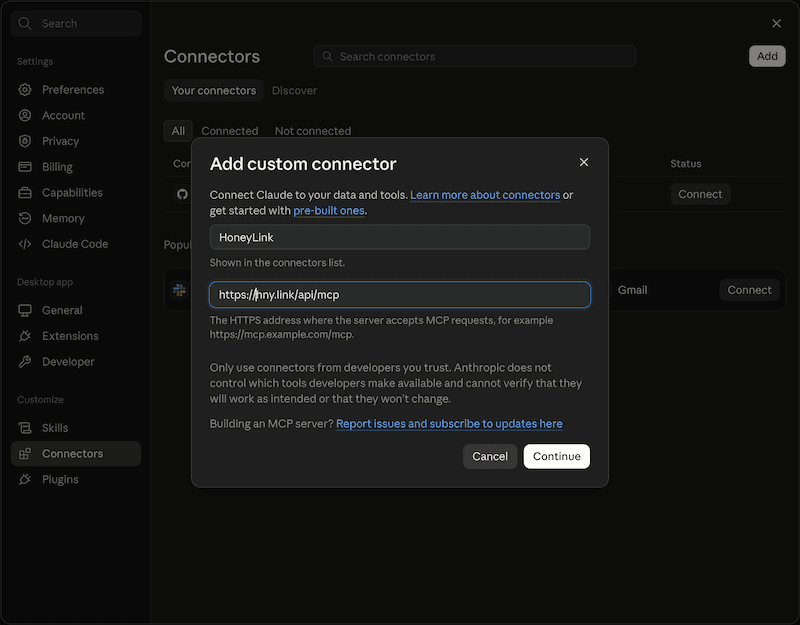
- Open Claude Desktop and go to Settings, then Connectors.
- Select "Add custom connector".
- Enter the HoneyLink MCP server URL shown above.
- Give the connector a name, such as "HoneyLink", and save it.
- Claude will check the connection and show its authentication and OAuth client details - select Add to continue.
- Claude will show that the connector has been saved - select Connect.
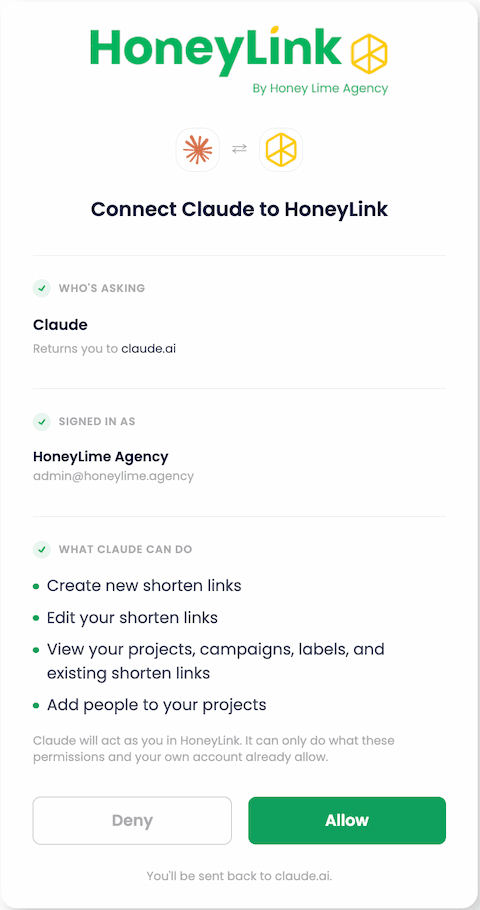
- Claude will open a browser window and ask you to sign in to your HoneyLink account.
- Review the permissions Claude is requesting, then select "Allow" to finish connecting.
Connect on ChatGPT Desktop
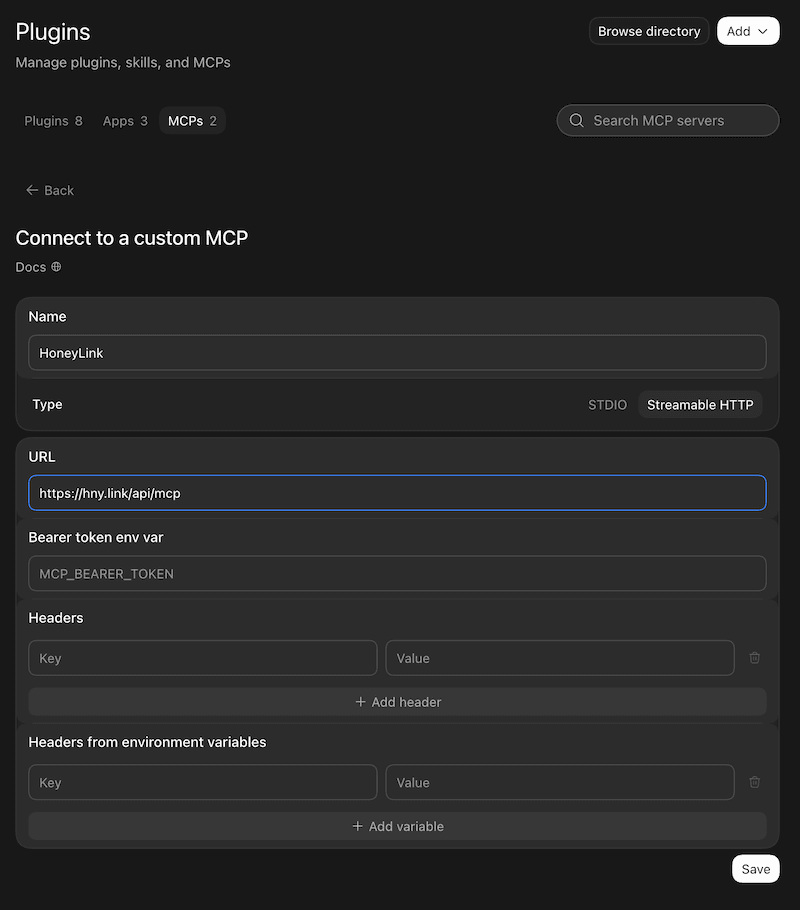
- Open ChatGPT and go to Settings, then Plugins.
- From the menu in the top-right corner, choose to add a new MCP server.
- Name it "HoneyLink" and set the type to Streamable HTTP.
- Enter the HoneyLink MCP server URL shown above, then save.
- ChatGPT will show that the connector has been saved - select Authenticate.
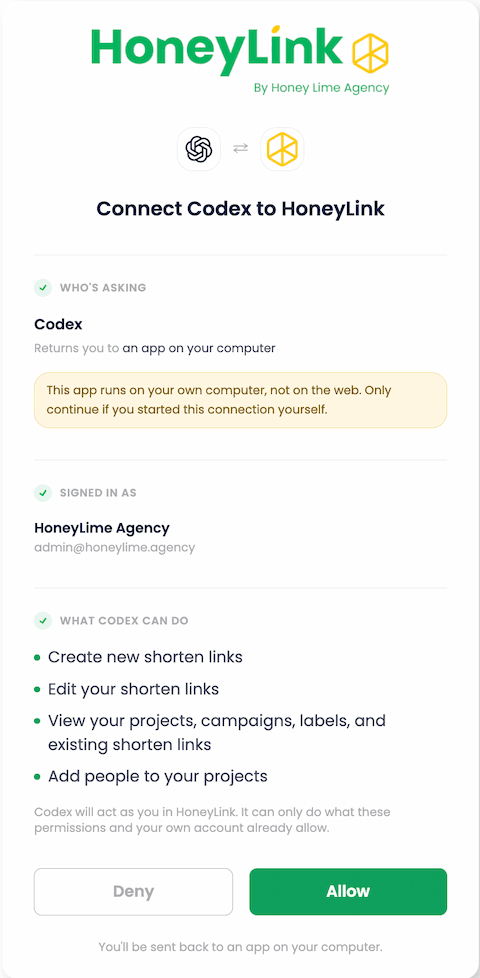
- ChatGPT will open a browser window and ask you to sign in to your HoneyLink account.
- Review the permissions ChatGPT is requesting, then select "Allow" to finish connecting.
Technical details
The section below explains how HoneyLink MCP works under the hood, including the OAuth authentication system and the list of MCP tools currently available for AI to use.
How authentication works
HoneyLink runs its own OAuth authorization server, and your AI assistant authenticates directly against it using the same account system as the dashboard. The connection uses PKCE (Proof Key for Code Exchange), so no client secret is ever stored on your device, and every access token is scoped to only the permissions you approved on the consent screen.
Automatic setup via Dynamic Client Registration (DCR)
Most AI clients - including Claude and ChatGPT - can register themselves with HoneyLink automatically the first time they connect, using a standard called Dynamic Client Registration (DCR). That's why connecting usually just means pasting in the server URL: there's no separate step where HoneyLink has to manually approve or set up each new AI client ahead of time.
Available MCP tools
Once connected and approved, your AI assistant has access to the following tools:
Shorten links
| redirect_rule.create | Create a new shorten link. |
| redirect_rule.update | Update an existing shorten link. |
| redirect_rule.list | List shorten links within a project. |
| redirect_rule.generate_short_url | Suggest available short URL slugs. |
Projects, campaigns & labels
| project.list_recent | List the projects you've recently worked in. |
| project.list | List all projects you have access to. |
| project.detail | Get a project's campaigns and labels in one call. |
| campaign.list | List campaigns within a project. |
| label.list | List labels within a project. |
Team
| project.invite_member | Add an existing HoneyLink user to a project. |
This list will grow over time as more of HoneyLink becomes available through MCP.
FAQ
Do I need a HoneyLink account to use this?
Yes. Connecting an AI assistant links it to your existing HoneyLink account - it doesn't create a separate account or bypass your account's own permissions.
Can I disconnect an AI assistant later?
Yes, at any time. Revoking access takes effect immediately and stops the assistant from making any further requests to your account.
Is my data shared with Anthropic or OpenAI?
Your AI assistant only sees the information it requests through HoneyLink while completing a task you asked it to do - the same data you'd see yourself in the dashboard for that project.
Which AI assistants are supported?
Claude and ChatGPT are supported today, using the same open MCP standard - support for other MCP-compatible assistants may follow.